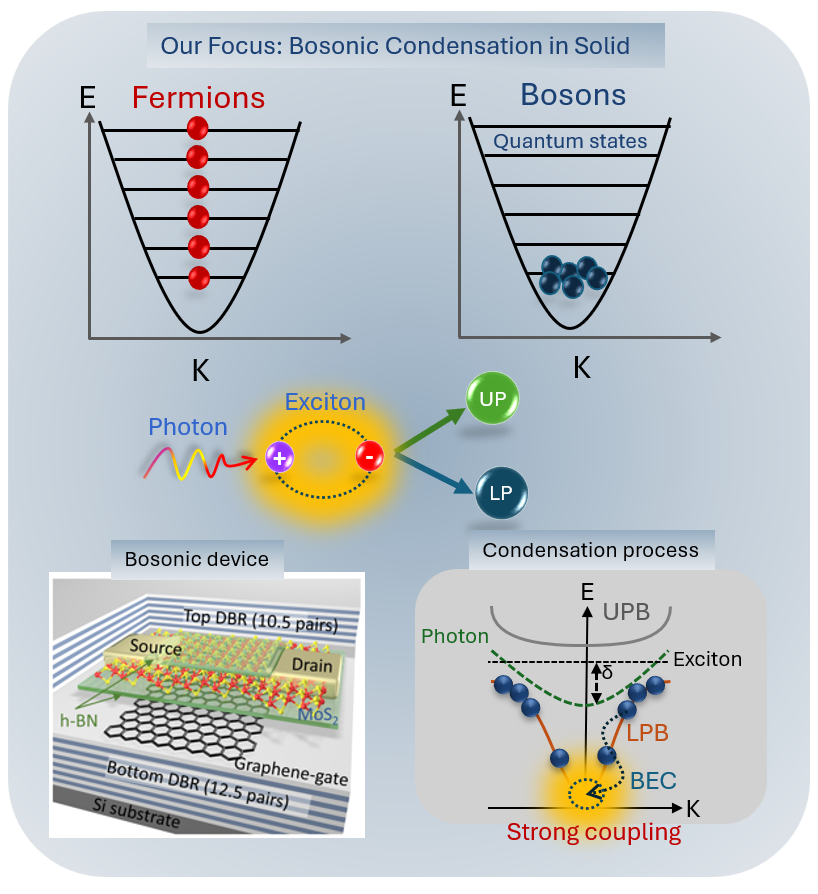
While exciton-polariton behavior in vdW transition metal dichalcogenides (TMDs) is well-studied, achieving electrical control over these polaritons remains a significant challenge. In particular, manipulating multiple polariton states and tuning polariton screening are key hurdles in advancing polaritonics toward practical applications. We have recently identified and electrically controlled various polariton states within a monolayer of n-type MoS₂, confined within a distributed-Bragg-reflector (DBR) microcavity. By incorporating a transparent graphene gate electrode and a hexagonal boron nitride (hBN) insulator, we achieved:
i) Trion polaritons with distinct lower polariton branch (LPB) and upper polariton branch (UPB) at low gate bias,
ii) LPB-UPB pairing at medium gate bias, demonstrating strong coupling interactions, and
iii) Complex polaritons (CPB) at high gate bias, arising from polariton screening effects.
We aim to explore gate-controlled polariton engineering across different temperatures to verify the possibility of Bose-Einstein condensation (BEC) in solid-state systems using an optical approach. Our specific objectives include i) Investigating temperature-dependent BEC transitions to determine the critical temperature for condensation, ii) Enhancing polariton screening control to manipulate interactions between multiple polariton states, and iii) Developing device-level demonstrations of BEC, paving the way for scalable polariton-based quantum computing architectures. A successful demonstration of device-level Bose-Einstein condensation at room temperature would be a transformative breakthrough in the field of quantum computing and optical computing. This could lead to revolutionary advancements in quantum information processing, providing an alternative pathway to low-power, ultrafast, and highly efficient optical computing devices.

Copyright © 2025 Institute of Low-Dimensional Quantum Materials, Hubei University of Technology.